
Which Diseases Is the Brain Pacemaker Used For?
The brain pacemaker (Deep Brain Stimulation – DBS) is a surgical treatment option applied when drug therapy proves insufficient for certain neurological conditions, including Parkinson's disease, essential tremor, dystonia, epilepsy, and certain psychiatric disorders.
The brain pacemaker (deep brain stimulation – DBS) is a surgical treatment option applied when drug therapy proves insufficient for certain neurological conditions. Through this method, continuous, controlled electrical impulses are delivered via electrodes placed in specific regions of the brain, regulating abnormal signal transmission. It has proven effective primarily in Parkinson's disease, as well as in essential tremor, dystonia, and certain cases of obsessive-compulsive disorder (OCD). The diseases for which the brain pacemaker is used are as follows:
- **Movement Disorders:** Parkinson's disease, essential tremor, dystonia, Huntington's disease - **Psychiatric Disorders:** Obsessive-compulsive disorder (OCD), Tourette syndrome, treatment-resistant depression - **Epilepsy** - **Chronic Pain**
What Is the Brain Pacemaker and How Does It Work?
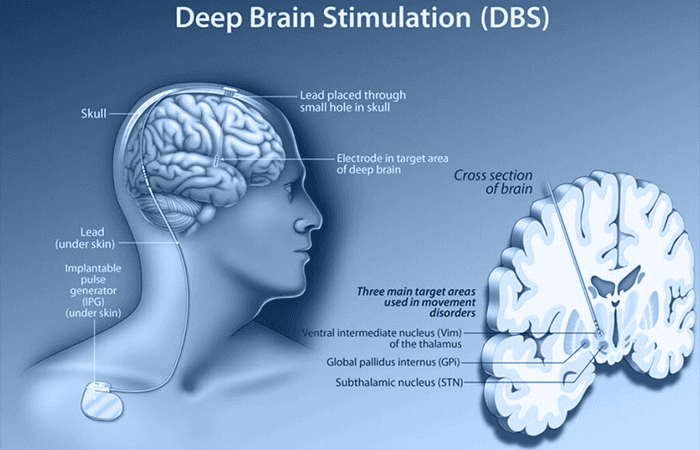
Deep brain stimulation (DBS), also known among the public as the "brain pacemaker," is a surgical method used in the treatment of certain neurological and psychiatric conditions such as Parkinson's disease, tremor, dystonia, and epilepsy. This technology aims to regulate brain activity by sending electrical impulses through electrodes placed in specific regions of the brain. Applied through a surgical procedure, the brain pacemaker works with a battery system connected to electrodes implanted in the disease-related brain region. The battery is placed subcutaneously in the patient's chest area.
**Surgical Procedure:** DBS surgery is typically performed in two stages. In the first stage, electrodes are placed in the targeted brain regions. In the second stage, a battery-like device (neurostimulator) placed in the chest area sends electrical impulses through cables connected to the electrodes.
**Electrical Impulses:** The electrical impulses sent from the neurostimulator help alleviate symptoms by regulating abnormal neural activity in the targeted brain region.
**Adjustment and Follow-up:** DBS treatment is personalized. Stimulation parameters (frequency, intensity, duration) are adjusted according to the patient's needs and monitored through regular medical check-ups.
Use of the Brain Pacemaker in Parkinson's Disease
Drug therapy begins once the diagnosis is established. In the first few years, patients may return to their pre-illness lives as if they were never sick. This period is called the honeymoon period. However, as the years progress, when symptoms such as tremor, freezing, rigidity, and bradykinesia can no longer be controlled despite drug therapy, when the duration of "off" periods throughout the day increases, and when involuntary dance-like movements emerge as drug doses are raised, it can be said that the time to consider brain pacemaker surgery has arrived. Brain pacemaker surgery is not recommended within the first 5 years from the time of diagnosis. The most important reason for this is that Parkinson's disease can be confused with other diseases. In such conditions called Parkinson-plus, brain pacemaker surgery unfortunately does not yield results as successful as it does in Parkinson's disease.
The Brain Pacemaker Method in Dystonia Treatment
The brain pacemaker method yields promising results, particularly in patients with genetically inherited dystonia who have been evaluated by neurologists and deemed suitable for surgery. Although improvement after surgery does not appear as immediately as in Parkinson's disease, it becomes more pronounced over time and continues to increase further after several years.
The Role of the Brain Pacemaker in Epilepsy Treatment
Vagal Nerve Stimulation, known among the public as the Vagus Pacemaker, Epilepsy Pacemaker, or Seizure Pacemaker, is one of the alternative methods used in the treatment of epilepsy. Generally applied to epilepsy patients who show resistance to long-term drug therapy, the vagal nerve stimulator is today more commonly applied to patients who have undergone surgical operations but continue to experience seizures. Following the procedure, epileptic seizures are significantly reduced. In some patients, seizures stop entirely. It is based on the principle of wrapping an electrode around the vagus nerve — which runs alongside the jugular vein in the neck — connecting it to a battery source, and having the generated electrical currents suppress abnormal activity in the brain.
Eligibility Criteria for Brain Pacemaker Treatment
For brain pacemaker surgery, the onset of the disease must date back at least 5 years. This is because Parkinson's disease can be clinically confused with certain other neurological conditions. Brain pacemaker surgery is not recommended for patients who experience frequent falls or for whom the medications they use provide almost no benefit even for a short period of time. Moreover, in patients with advanced falling and balance problems in particular, a certain increase in complaints may even be observed after surgery.
Similarly, brain pacemaker surgery should not be performed on patients with severe psychiatric depression or those with a serious mental disorder called psychosis. Because patients with Parkinson's disease may experience sadness and anxiety related to their reduced quality of life and restricted lifestyle, mild clinical psychiatric conditions of this kind do not constitute a barrier to surgery. However, for the more severe psychiatric problems mentioned above, drug therapy should be initiated first, and this surgery should be performed only after the patient's psychiatric treatment is complete.
Patients who have had such complaints in the past and have recovered with psychiatric drug therapy must be monitored closely following brain pacemaker surgery. Before the operation, this information must be shared in detail with the patient and their relatives. Another barrier to surgery is patients whose cognitive status is below what is expected for their age. Brain pacemaker surgery should also not be performed on patients with signs of dementia. Furthermore, brain pacemaker surgery is also not appropriate for patients with other severe and uncontrolled chronic conditions. However, controlled conditions such as hypertension, heart disease, or diabetes are not an obstacle to surgery.
Other Neurological Diseases Treated with the Brain Pacemaker
The brain pacemaker is also used for the following conditions:
- Parkinson's disease - Essential tremor - Dystonia - Epilepsy